

No-script jubensha? Yes, and it works!
One key difference between jubensha and any other type of entertainment (well, besides reading a book!) is the amount of reading you need to do in order to get to the juicy part. Personally, I think it’s what allows jubensha to be so fun, allowing the author to create depth and tension you wouldn’t have otherwise. But for many others, it’s a barrier to entry. People just don’t expect to sit down and read for 5, 10, or 30 minutes before starting a game.
Whenever I feel like the reading time might be too high for people interested in but hesitant about jubensha, I recommend them the only jubensha I’ve played that has NO scripts whatsoever! You start picking up clues and discussing right out of the gate. For those already familiar with jubensha, this structure might feel impossible.
But it works! Let me show you how without spoiling anything you wouldn’t already know in the first 10 minutes of the game.
The game I’m referencing is Memento, a beginner-friendly 7-player 3 hour game that plays well both online and in-person. It’s one of the few games I participated in myself instead of starting out as a GM. (Our group somehow took 5 hours😅)
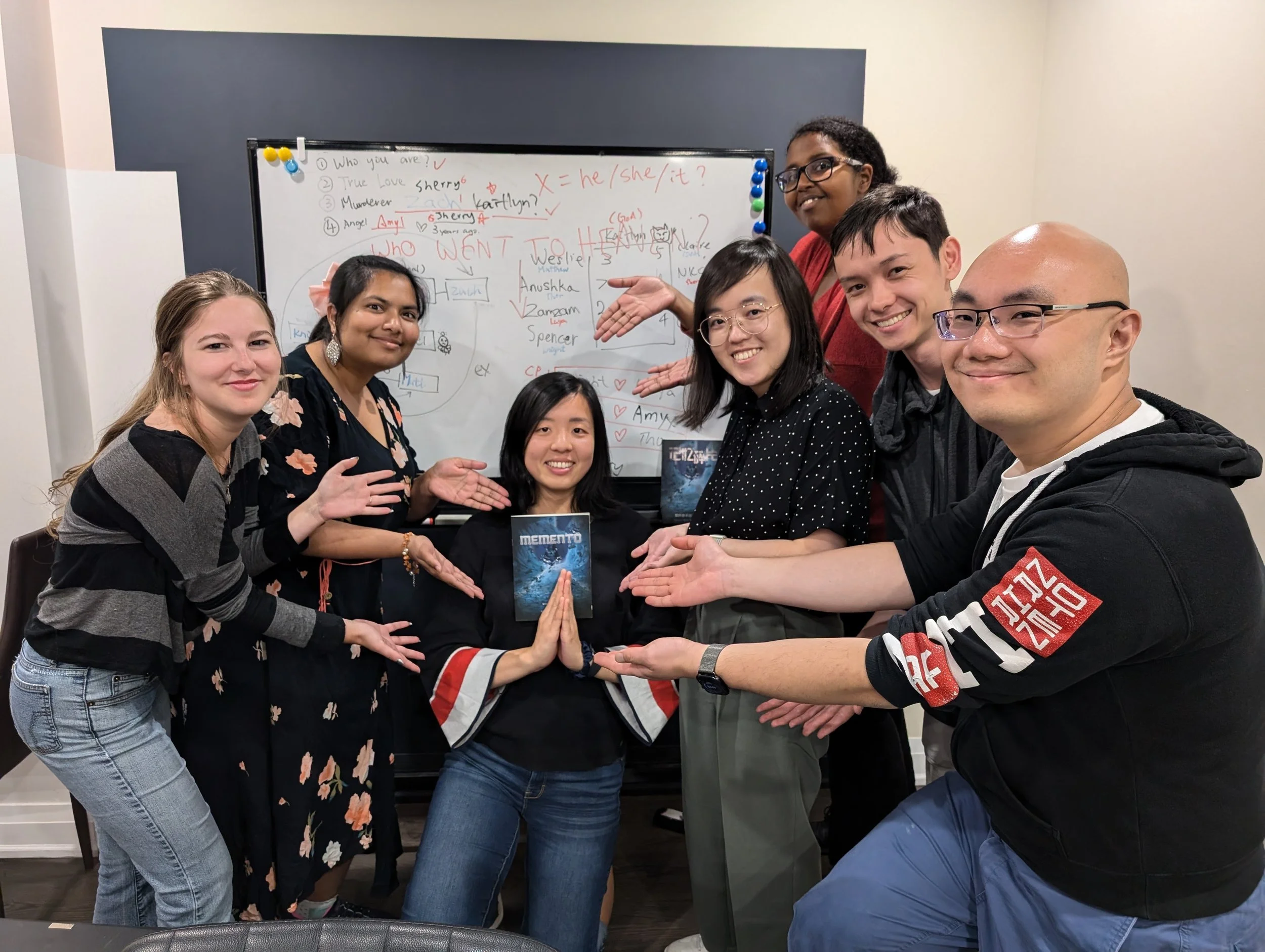
Taken moments after I got away with murder…
In Memento, the GM is the grim reaper speaks to the players, all of whom are merely specks of light in an endless void. That’s right, we’ve all died. The grim reaper challenges us to find out who the murderer was, how they did it, and why before their hourglass (set for 3 hours) runs out. As we’ve all lost our memories in the certainly traumatic event of our death, the grim reaper will restore random fragments of our memories over the course of the game. Those are the clue cards we receive. And of course, total amnesia means no script to start with.
If we failed, hell awaits. And if we succeeded, we enjoy the fruits of heaven with our true love. True love, you ask? Yep, there was a secondary goal to find who your true love is! And since there were seven and all couples were monogamous, one person was inevitably left out. Their goal: convince someone that they were meant to be together. Another layer of deception added plenty of spice to an already unique murder investigation.
The true love objective was a great foreshadow as to what the game turned out to be. A massive web of relationships, heartbreak, hope, and drama that could rival the messiest of soap operas (and I mean this in a good way!). For our group, we ended up whiteboarding all the characters and drawing lines between them, ending up looking like the conspiracy guy meme.
The fun of this game was not so much on the role play (it’s hard to role play a person you can’t remember being) but more on the story reconstruction. It’s the jigsaw puzzle version of jubensha: the goal is to put all memory fragments in the right place in the overall story. Did this memory happen way in the past, or just recently? Who was talking in this memory? Who were they talking about? A million questions were asked and we had to collaborate (but perhaps not completely, since I was the murderer…) to combine memories that fit together.
I took a short video snippet of my playthrough, but it contains SPOILERS! Only watch if you’re certain you don’t want to play it (or have a bad memory).
If this piqued your interest and you’re looking to play Memento, I offer my own unofficial translation of this game online over Discord or in-person in Toronto. Check it our here. If you live in a major city with a sizable Chinese-speaking population, your local Chinese jubensha shop might have the official translation which is the one I played with. Unfortunately, it wasn’t very good and we spent a lot of the time trying to decipher the translation too… But it was still a ton of fun!
I hope you enjoyed learning about a unique jubensha structure. What are your thoughts on this kind of game? Would you try it out?
