

Designing a Jubensha Game? Start here!
English-language jubensha writers have the cards stacked against them. Imagine trying to write a screenplay only knowing the idea of a movie and if you’re lucky, having seen one or two. With limited existing options in English, the conditions to support prospective jubensha authors and create original English-language games are just not there. Thus resulting in the lack of English language games. It’s sadly a vicious cycle.
I want to help break down this cycle by sharing my most impactful tips on designing your own jubensha game. The source of this knowledge? I’ve written three original jubensha games, the most recent of which is currently being published for an early 2026 release. Over 3+ years of designing, testing, and hearing feedback on dozens of both translated and original games, I’ve learned what people love and don’t love about jubensha games, and I’m here to share this knowledge with you!
I was recently asked about how I start writing a jubensha game and it got me thinking. Perhaps I start with an eccentric cast of characters, or maybe a head-scratching means of murder, or even the interesting secrets that a character could be hiding? But after some further thought, I realized the first step to creating a jubensha is much more fundamental:
Determine what game experience you want your players to have
Jubensha can take many forms, so the first question is: what kind of game do you want to create? This is almost like the jubensha equivalent of deciding a novel’s genre or the main mechanic of a board game. It’s hard to start designing anything without knowing the building blocks of the jubensha experience you want to create.
What does a jubensha game experience consist of exactly?
To add structure to a rather vague question, I’ve reviewed dozens of jubensha games and organized those experiences into 5 dimensions. I often use these dimensions to compare and contrast my jubensha offerings to interested players, and they’re also a useful starting point for jubensha designers for that exact reason. Jubensha players want to know what they’re getting into when they pick up your game!
These dimensions are: story reconstruction, timeline reconstruction, emotional role play, logical deduction, and character relationships. Here are my descriptions:
Story Reconstruction
What happened in the characters’ pasts? This usually isn’t about the events of the murder, but a wider plot that eventually links every character in the game. Perhaps they attended the same event in the past, they know the same person, or they have a unique trait in common, etc. As the game unfolds, the characters learn more about this story.
Timeline Reconstruction (Check out my how-to guide here!)
This is all about the events of the murder. Here, you’d be asking questions like: Where were you at this time? Who were the two people who bumped into each other in the dark? When did the scream happen? Accounting for where everyone was, what they were doing, and who they were with is what I would consider timeline reconstruction.
Emotional Role Play
Creating a character with depth is the key to this. If you have experience writing character-driven fiction, all those skills apply here. You’ll want to add moments that garner strong emotions from the player, whether it be romance, friendship, horror, comedy, etc. Jubensha in this category will spend more time in the script to develop the character and their emotional states, immersing players into the minds of their character.
Logical Deduction
Although timeline reconstruction is technically a form of logical deduction, I felt that another category for all other deduction was warranted. This category is hard to define, as it’s the “puzzle” part of jubensha. Many of the most popular Chinese jubensha have creative puzzles (beyond timeline reconstruction) to definitively nail the murderer, but only if you can put the pieces together correctly. This would be the equivalent of having a big twist in a murder mystery novel or the showstopping mechanism of an escape room.
Character Relationships
For jubensha that focus heavily on character relationships, you’d want to whip out a whiteboard, write down all the characters’ names, and draw dozens of lines between them with little labels. As you peel back layer after layer, the true nature of relationships begin unraveling, and you’ll end up with a massive web of relationships—perhaps some unbeknownst to the characters in question!
How do I use these dimensions?
I recommend picking 1 main dimension as the backbone of your jubensha game, and 1 or 2 secondary dimensions to supplement it. When I wrote Worms Against Humanity (check it out here for free!), I knew from the beginning I wanted the timeline reconstruction to be the main feature. Second most important was discovering the character relationships. My next step became very clear: figure out the events of the murder! You want to allocate most of your design time to building the main feature of your game, after all.
Not sure how to decide which dimensions to focus on? Write what you enjoy playing! If this part is truly a struggle or if something else is more important (e.g. you’ve already decided on the setting, characters, theme, etc.) then go for that first and decide the game dimensions later. My advice remains that the dimension proportions should be decided relatively early so you have a clear vision of your end experience.
Things to keep in mind
These dimensions aren’t completely separate, as you can imagine story reconstruction might go very well with character relationships and emotional role play. But just like how comedy and romance often go together as genre combinations, this doesn’t mean that you won’t find thriller comedies, horror comedies, or dramatic comedies—they’re just less common. Create a combination that works for the experience you want to convey.
At the end of the day, these dimensions should act as a guide to narrow your focus. A single jubensha can’t contain all five elements and execute them all to maximum effect, though the best ones excel at multiple dimensions (but that shouldn’t be the aim with your first jubensha).
To illustrate, here’s how I would rate the four most popular translated scripts hosted by Twist ‘n Turn Studios:
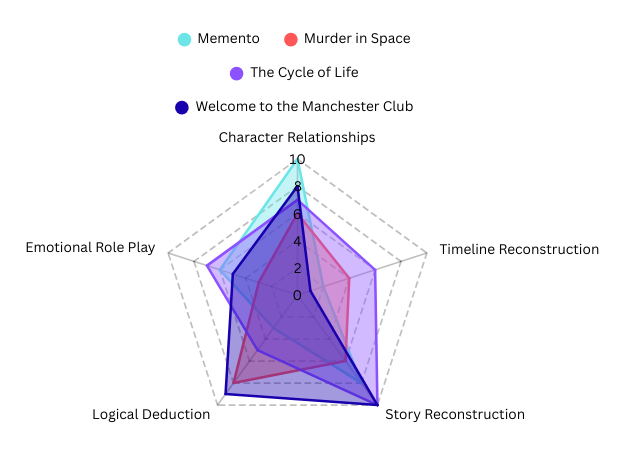
Popular jubensha assessed by category
I hope this starting guide helps with new jubensha writers! I’ll soon post about what to do after you’ve determined your game dimensions, and how to flush out each type of game with compelling plot, characters, motives, and more. Stay tuned and comment if you have questions or feedback!
